
PUBLISHED31 Aug 2026
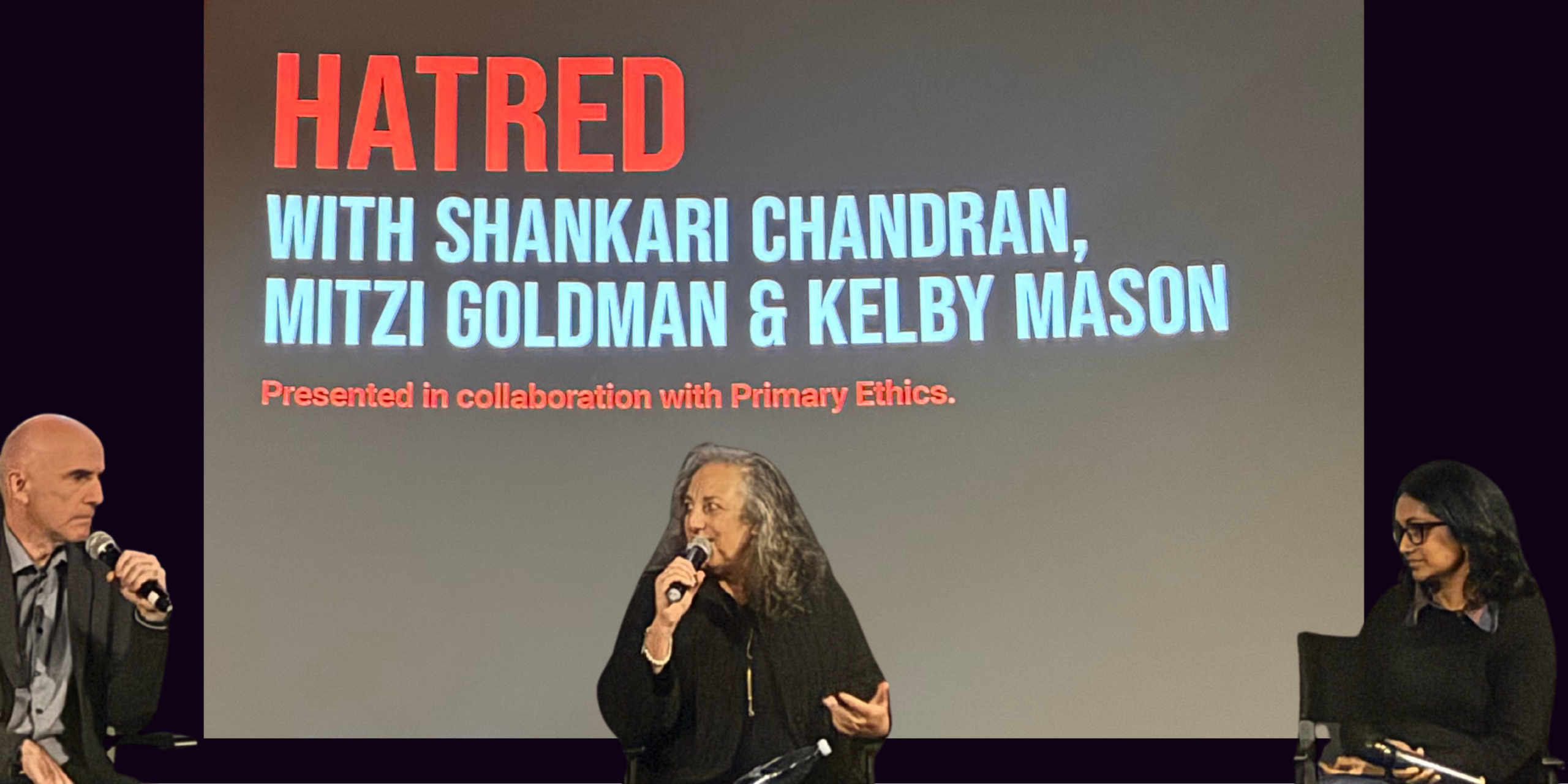
Hatred screening at Festival of Dangerous Ideas
Reflection by Dr Mitzi Goldman
Hatred – then and now: With the impact of time, what has changed? What remains relevant today? 30 years on, what is still dangerous about the documentary?
There are things that have not changed – people’s predisposition to hate, we have always hated but we haven’t always admitted it so fervently. Even 30 years ago, there was something of a taboo about admitting to hatred. When I was brought up if I said, “I hate someone or something” my mother would quite quickly say, “You don’t hate, you dislike intensely.”
Today, I think people wear their hatred like a badge of honour, like a pride, almost a “right to hate”. This is an interesting change as people are far more vocal publicly about their hatred. 30 years ago, I was encouraging people to speak about hatred, to own up to it in themselves. This presents itself today as a dangerous idea.
One of the biggest changes between then and now of course is the amplification of hatred, the amplification that social media enables and the divisiveness that the algorithms create and we’re all aware of the echo chambers and confirmation biases that are happening around misinformation, lies and deceit. That landscape has changed.
Is it ever ok to hate?
Given that we all have the emotional capacity to hate, we tend to be socialised out of expressing it, as it is anti-social and potentially destructive in many ways, but there are times when it could be justified. When we might understand why a person’s reaction to a situation is one of hatred.
For example, if someone is being constantly abused, terrified, controlled, like in a domestic violence scenario, trapped and aggressed – it is understandable they might feel hate towards that person. It might be necessary on some level to feel hatred to activate the motivation to protect oneself, to leave or to report the abuse. If someone threatened you or killed your child, I would say it would be understandable to hate, and it would be an honest and rational emotional response to a situation like that. I think that hatred is quite ordinary.
What is extraordinary is to see people rise above the violence that has been done to them and NOT hate. Indeed, some people are capable of this. I also think that in the face of consistent oppression and injustice towards a population at scale over extensive periods of time with no sign of change, hatred can be appealed to, to motivate movements en masse to rise up and demand self-determination, justice and freedom. We have seen this throughout history. Perhaps not every individual hates and it is not the only thing happening in those movements, but it can be an energising and uniting force in movements that demand human rights and justice. Hatred, as a reaction to the perpetration of evil, is understandable and even reasonable?
Dialogue vs silence: Discourse and discomfort when we disagree, learning to converse despite grief and rage – what’s the impact for future generations?
This has become increasingly difficult over the last few years, and it saddens me. I am committed to listening and to sit in uncomfortable conversations rather than not have them, but I must admit this has become so much harder. There is so much shouting and shaming that at times I have chosen silence because there are too many voices, too many words being thrown around carelessly, recklessly. It is better to have these conversations and have become less reactive and less judgemental, but I do also recognise that there are times when it is more strategic to remain silent.
My mother-in-law would say, “You just missed a great opportunity to keep your mouth shut”. However, having said that, I agree that we must learn, particularly for the next generations, to dialogue and disagree in robust yet respectful ways. There are no singular truths or singular rights. There are many contradictory truths that exist alongside each other and competing rights.
Persisting with brave and difficult conversations: Making space for speaking and listening after trauma, inter-generational experience, truth seeking before justice – when is the right time to tell the truth?
We must persist and learn to listen to peoples’ truths that are often personal, formed by inherited trauma and lived experience even when or especially when it is challenging and we might feel implicated in the accusations that are made about our “people”. This is what we have been seeing, a reactive breakdown in the ability to communicate, and we retreat to our corners, like boxers in the ring. I try to practice understanding, as a muscle practice, even when I can feel that inside, I am violently disagreeing. I ask myself, while I am listening, “Why does this person believe themselves so unequivocally, what has formed this position in them? Are they informed? Are they thinking for themselves? Have they been personally traumatised? What do they need to prove to themselves? Is there a moral compass?” It’s almost like a disembodied philosophical enquiry.
Identity, nationalism, belonging: What are the connections between culture, community, nationalism and exclusion?
This is so messy, personal and often so hard to disentangle. It is very personal yet there are constant assumptions made about people from an ethnic group being the same, sharing the same politics and convictions. Indeed, this is the very basis of racism. I can only speak for myself on this one, I would define my Jewish identity very differently from someone else and would not assume, and ask others not to assume, that because I am Jewish, I hold certain views. But, of course, I am of that ethnicity and culture, and a racist would not stop to ask me about the nuances of my political position.
Race vs gender-based violence: Would the latter feature more if the film was made today?
There is only so much that you can fit into a one-hour documentary, you need to make choices. I don’t think there is more gender-based violence today than there was 30 years ago. There has always been violence against women. It is shocking to me that there is still such barbarism towards women in so many parts of the world. Of course, the whole topic of men’s entitlement over women is a subject of many films, literature, art and many documentaries to come. We can’t talk about race vs gender-based violence – human rights, equality and justice for all people is a constant struggle and will remain so. We can never take our foot off the gas, and we must pass the baton and the knowledge to future generations so they can keep up the fight. We must constantly hold power to account.
Storytelling: What is the role of film, literature and personal stories in confronting hatred and preserving memory?
For me storytelling and sharing our personal experiences with future generations is one of the most important and powerful tools we can use to bring about change. It has always been the case. It is the human condition, oral histories, culture in verse, in song, keeping culture alive in the diaspora through food, intergenerational sharing and particularly with stories that complicate the narrative. We are not all the same. Each child in any family has a different experience and a story of the same family.
We all have our own stories to tell, and we all have an individual accountability for how we show up in the world. How we treat others, how we role model behaviour, how we think critically and embrace different world views. It is only each one of us as individuals who can forge our own moral path and act for a better world. We hope and we do find others who share our values and we team up, but at the end of the day we are all morally accountable to ourselves.
Hope and personal action: Is there shared responsibility to challenge hatred and continue difficult conversations?
I think we do have a shared responsibility to learn how to have respectful conversations with people who think and feel differently to us. We can respectfully disagree and then the challenge is to still work together rather than retreating into our separate corners.
How do we stand together, where are the commonalities rather than the differences? I think we also need to recognise that hatred is ordinary, we can’t always silence it or repress it, nor should we, but if we acknowledge it, then it is the first step towards engaging with the humanity that we all share.
We all feel fear, pain, we all want to be heard, seen, respected – I am optimistic that when we channel these commonalities and our own agency to behave humanistically then dialogue, solidarity and change is possible.
We’ve seen this repeatedly throughout history. Sometimes we must choose to believe, even in the face of disbelief. I believe that change is possible, justice needs to be fought for and maybe then, peace will follow.