
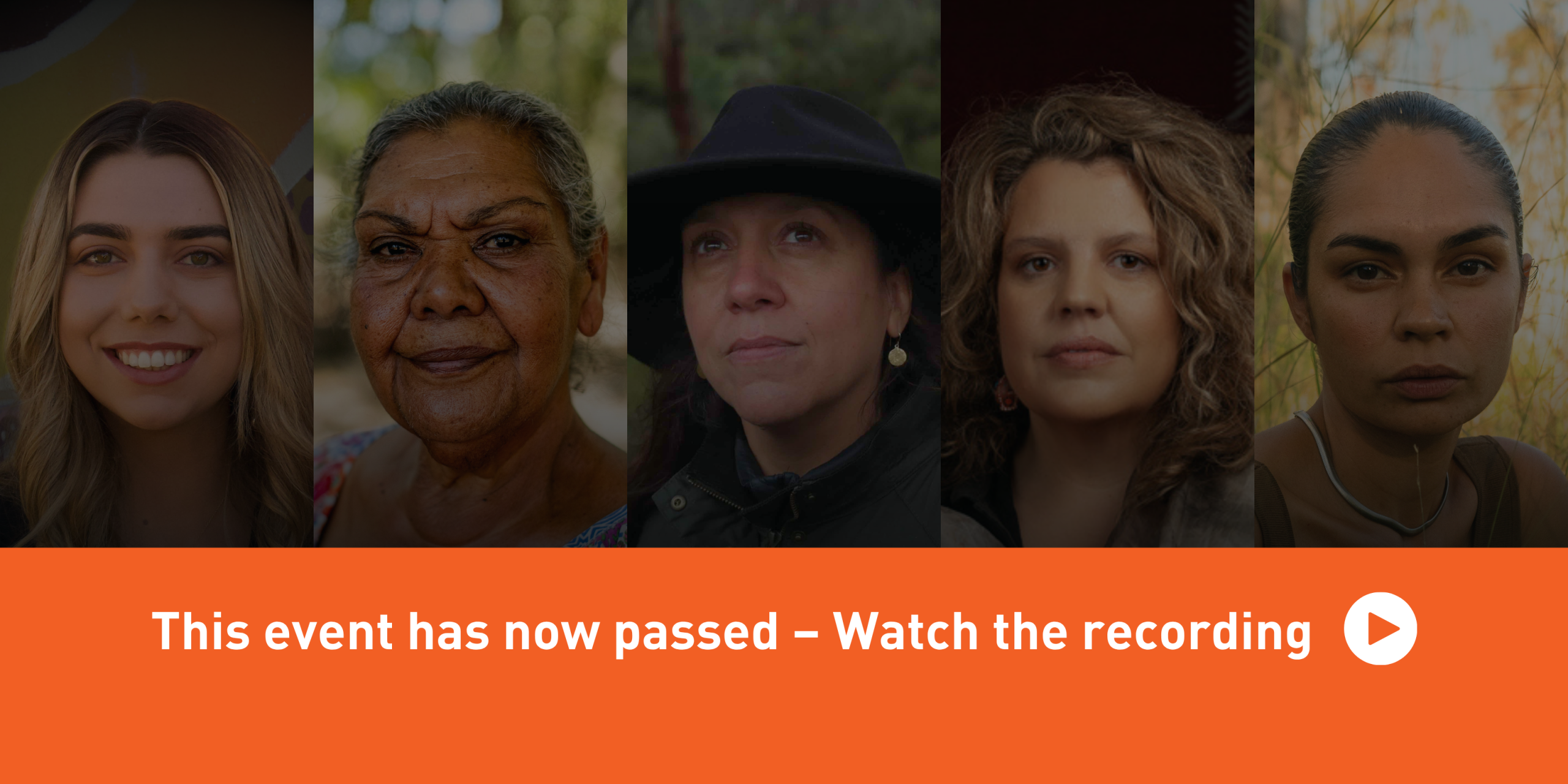

First Nations Women’s Voices: Stories of matriarchy for systems change
Join us for the second event in Documentary Australia’s Women’s Voices series, an online panel discussion on First Nations storytelling that shifts the narrative and centres matriarchal and women’s knowledges.
Tune in on Thursday 30 July at 12pm to hear from Wiradyuri, Ngemba and Paakantji woman and Common Ground CEO Gemma Pol in conversation with:
- Bunuba leader and Wiyi Yani U Thangani (Women’s Voices) Chair, June Oscar AO
- Arrernte and Kalkadoon filmmaker and Screen Australia Director of First Nations Strategy, Rachel Perkins
- Worimi artist, filmmaker and field builder, Genevieve Grieves
- Nyikina Warrwa and Wangkumara Barkindji filmmaker and legal academic Marlikka Perdrisat
The speakers will discuss storytelling as a practice of care, and as a powerful tool for narrative and systemic change.
This event is presented as part of Documentary Australia’s Women’s Voices initiative, which elevates stories from women, girls and gender-diverse people that shift the narrative and drive progress for gender equality and justice. Learn more or support Women’s Voices here.
About the speakers
Gemma Pol is a Wiradyuri, Ngemba and Paakantji woman who grew up in a small coastal town on Worimi Country. Her mob are the Beetsons and the Higgins. She is the CEO of Common Ground First Nations and a non-executive director at Firesticks – working across storytelling and systems change to build movements that protect people and Country.
With a background in communications, Gemma specialises in strategic storytelling for social impact and systemic change. She sees storytelling as a powerful tool to build collective understanding, shift structures and strengthen cultures – now and for future generations.
At Common Ground, she works with a team committed to creating space for First Nations storytellers to share their stories, their ways. Through digital storytelling, learning resources, capacity building programs and place-based story recording projects, Common Ground works to ensure First Nations knowledges are protected, cultures are celebrated, and truth-telling is centred in national conversations.
June Oscar AO is a proud Bunuba woman from the remote town of Fitzroy Crossing in Western Australia’s Kimberley region.
June is an international advocate for First Nations social justice and women’s issues, and the impacts of intergenerational trauma and the need to restore societal wellbeing through the revitalisation of cultural practices, languages and connection to land and water. She has worked tirelessly to reduce Fetal Alcohol Spectrum Disorder (FASD) and led a successful community-driven campaign for alcohol restrictions in Fitzroy Crossing.
June has held a raft of influential positions, including Deputy Director of the Kimberley Land Council, Chair of the Kimberley Language Resource Centre and Chief Investigator with WA’s Lililwan Project addressing FASD.
In 2013, June was awarded an Officer of the Order of Australia for distinguished service to the Indigenous community of Western Australia, particularly through health and social welfare programs. In 2015, June received the Menzies School of Health Research Medallion for her work with FASD. In 2016, she was the recipient of the Desmond Tutu Global Reconciliation Award, she was named NAIDOC person of the year in 2018, and in 2019, she was bestowed the honorary role of a Distinguished Fellow of ANZSOG.
In April 2024, June completed her seven-year term as Australia’s Aboriginal and Torres Strait Islander Social Justice Commissioner. As Commissioner, she published the landmark Wiyi Yani U Thangani (Women’s Voices) Report. In March 2024, June founded the Wiyi Yani U Thangani Institute for First Nations Gender Justice, based at the Australian National University. The Institute, a global first, will continue the vital work of Wiyi Yani U Thangani and advance and respond to the rights and aspirations of First Nations women and girls, inclusive of cis and trans women and gender diverse mob.
Rachel Perkins is an Arrernte and Kalkadoon woman with German and Irish heritage, and one of the nation’s most renowned screen practitioners. An agenda-setting filmmaker and policy leader, Rachel has lent her high-level expertise to many influential organisations in leadership roles across Screen Australia, AFTRS, SBS, ABC, NITV, the Australian Film Commission, First Nations Heritage Protection Alliance and more.
As a co-founder of production company Blackfella Films, Rachel has long driven and shaped First Nations storytelling in Australia with a strong focus on self-representation, told by and with Indigenous media practitioners. Her credentials include work on award-winning projects Mystery Road, Total Control, The Australian Wars, Redfern Now, Bran Nue Dae, Radiance, Mabo and First Australians.
In the newly created role of Director of First Nations Strategy, Rachel leads the strategic direction for Screen Australia’s First Nations Department and the broader sector by shaping recommendations for future policy, guiding investment priorities and driving engagement with government, culture and screen industry stakeholders.
Genevieve Grieves is a proud Worimi woman and respected artist, educator, field builder, film director and oral historian. She is internationally recognised as a leader of community engagement and decolonising methodologies.
Co-Creator and Creative Director of GARUWA, Genevieve champions projects that place First Nations knowledge and culture at the core. Central to her practice is intercultural and intergenerational knowledge transmission, in which she builds bridges between disparate communities and paves the way for future generations of First Nations storytellers, developing initiatives like the annual First Nations Impact Lab, co-presented with Doc Society.
In 2024 Genevieve was awarded the Natalie Miller Fellowship in recognition of her “impressive career in the screen sector, collaborating with community along with a dedication and passion for content creation and storytelling”. Genevieve Grieves profound commitment to positive systems change has led to numerous award-winning film and museum experiences including First Peoples at Bunjilaka Aboriginal Cultural Centre, Melbourne Museum, Lani’s Story (SBS), Motherhood in the Colony and Power to Country (ABC), a short film and impact campaign that saw the successful installation of renewable energy for Mumuthumburru (West Island, NT), enabling the community to return home.
Genevieve’s commitment to social change is underpinned by her work as co-founder of Shifting Ground, supporting organisations and individuals to be empowered to think, talk and act on issues of culture and race through workshops and training. It is also exemplified in the “Working in First Peoples Contexts” course she teaches at RMIT University where she is a Doctoral Fellow.
Genevieve serves on the boards of Arts Pay, Darwin Community Arts, Original Power and Koorie Heritage Trust. In 2024, Genevieve co-edited “Art & Memorialisation: Truth-telling through creative practice in settler colonial Australia” with Dr Amy Spiers, examining the injustices committed against First Peoples and the public memorialisation of these difficult histories.
Nyikina Warrwa and Wangkumara Barkindji filmmaker and legal academic Marlikka Perdrisat grew up holding a strong relationship with Land, which is felt in each of her projects.
Marlikka started in short form with the successful series Concepts of Country, which created national conversations around Nyikina language, land and law. Marlikka’s first short film Babanil premiered at Sydney Film Festival, and internationally at ImagineNative in 2023. With her second film, Ornmol, Marlikka wanted to share how growing up with Land creates confidence and joy in young people. The short documentary premiered at Flickerfest and was selected for Berlinale.
Learn more about or support Documentary Australia’s Women’s Voices program